Android music player
Every bit reaches your DAC exactly as recorded.
Lydex is a high-fidelity Android music player built for audiophiles. A professional-grade USB DAC driver delivers bit-perfect lossless output, bypassing the system audio chain to hand the original audio data straight to your external DAC.
A flexible DSP plugin system, room to extend it, and capable local library management let Lydex adapt to any device and any listening preference — so your headphones, speakers and professional audio gear perform to their full potential.
- Exclusive USB DAC drive
- Flexible DSP plugins
- A capable media library
- Built-in DAC passthrough1
- 1Requires root. Supported on selected DAP models today, with more being added. See supported devices →

Android 12 and later64-bit ARM device
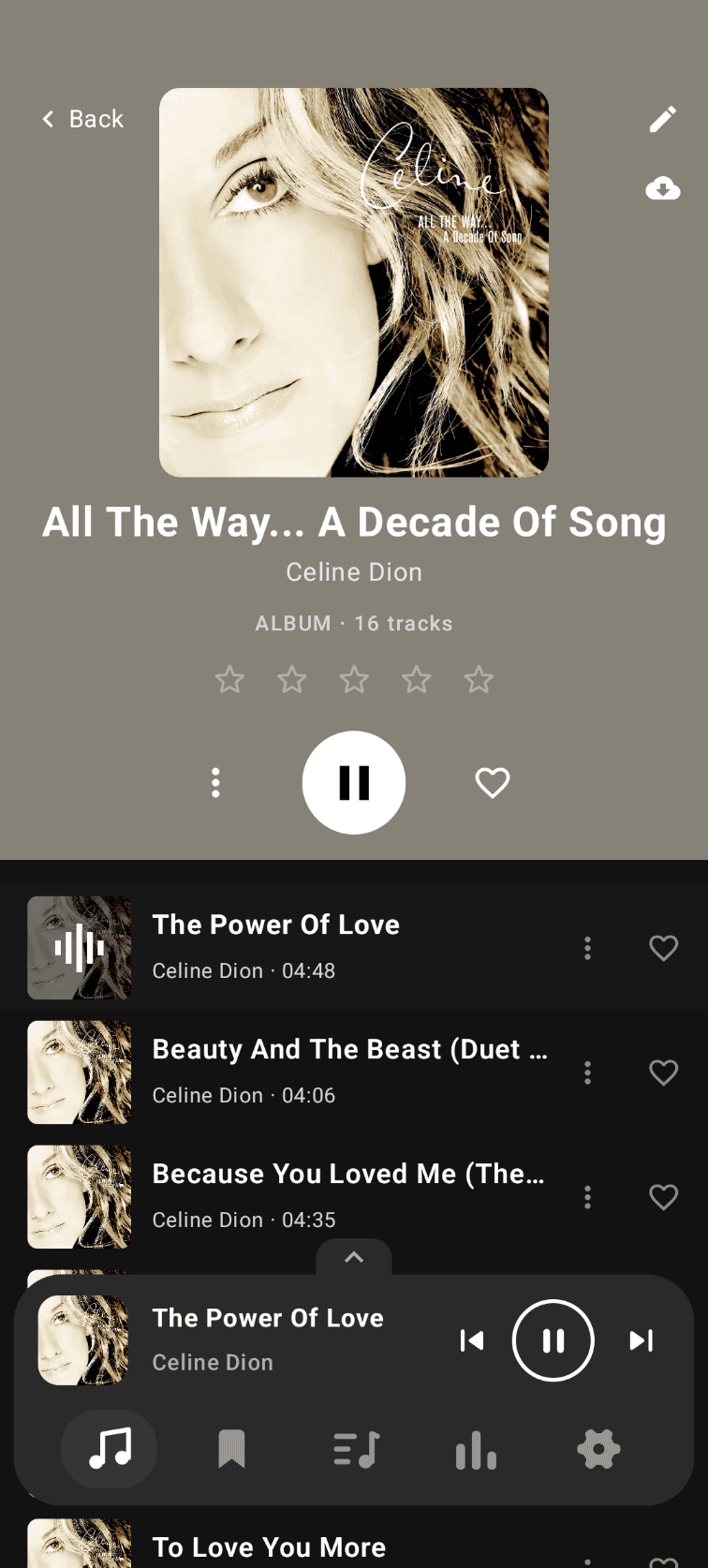
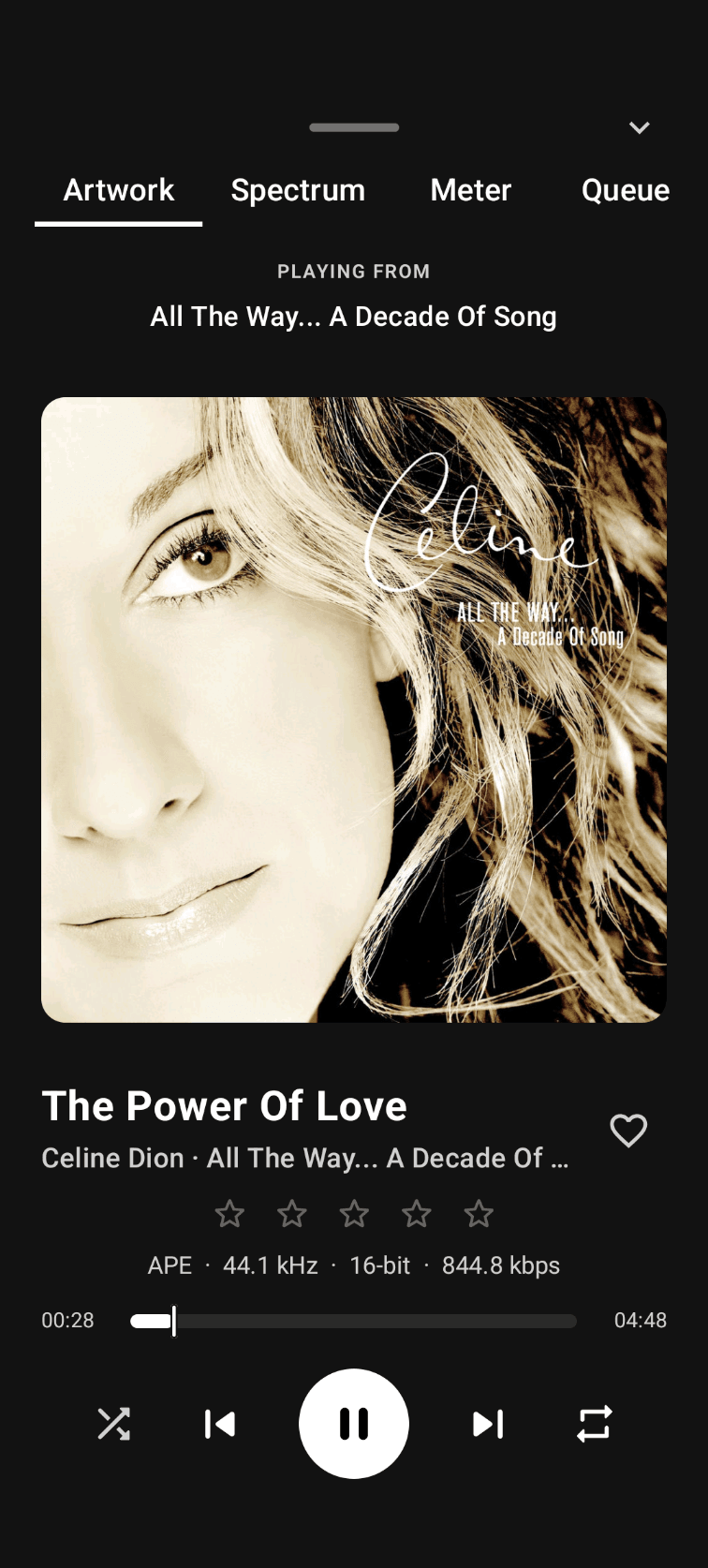
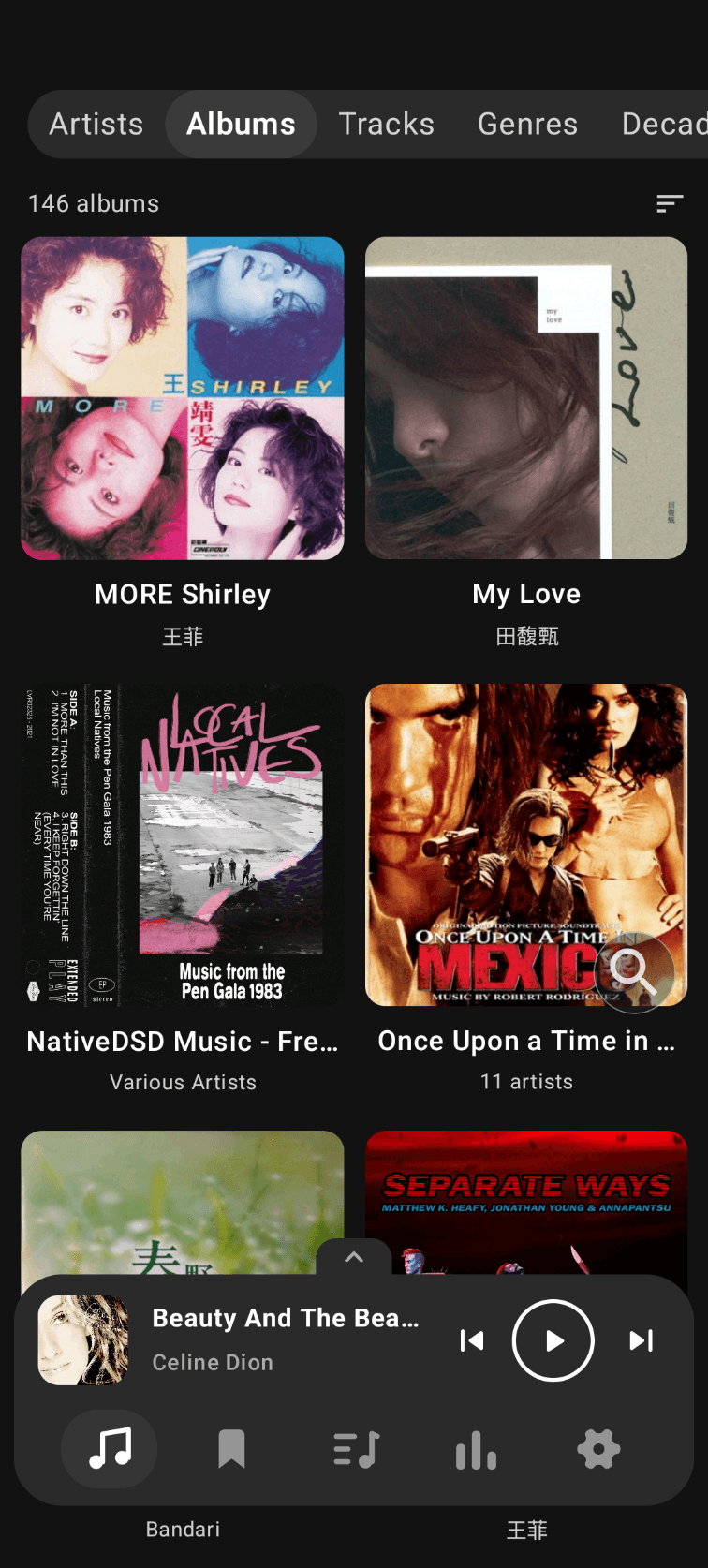
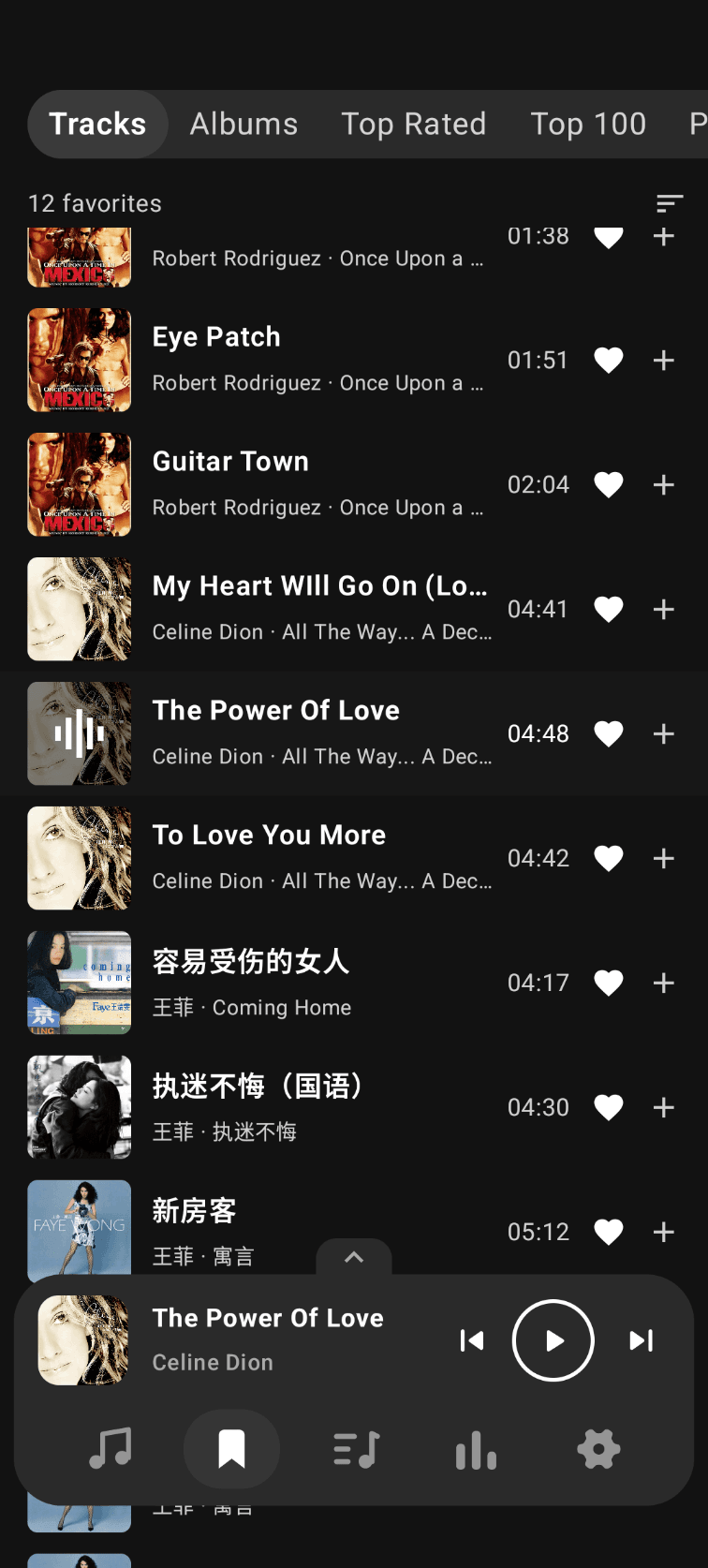
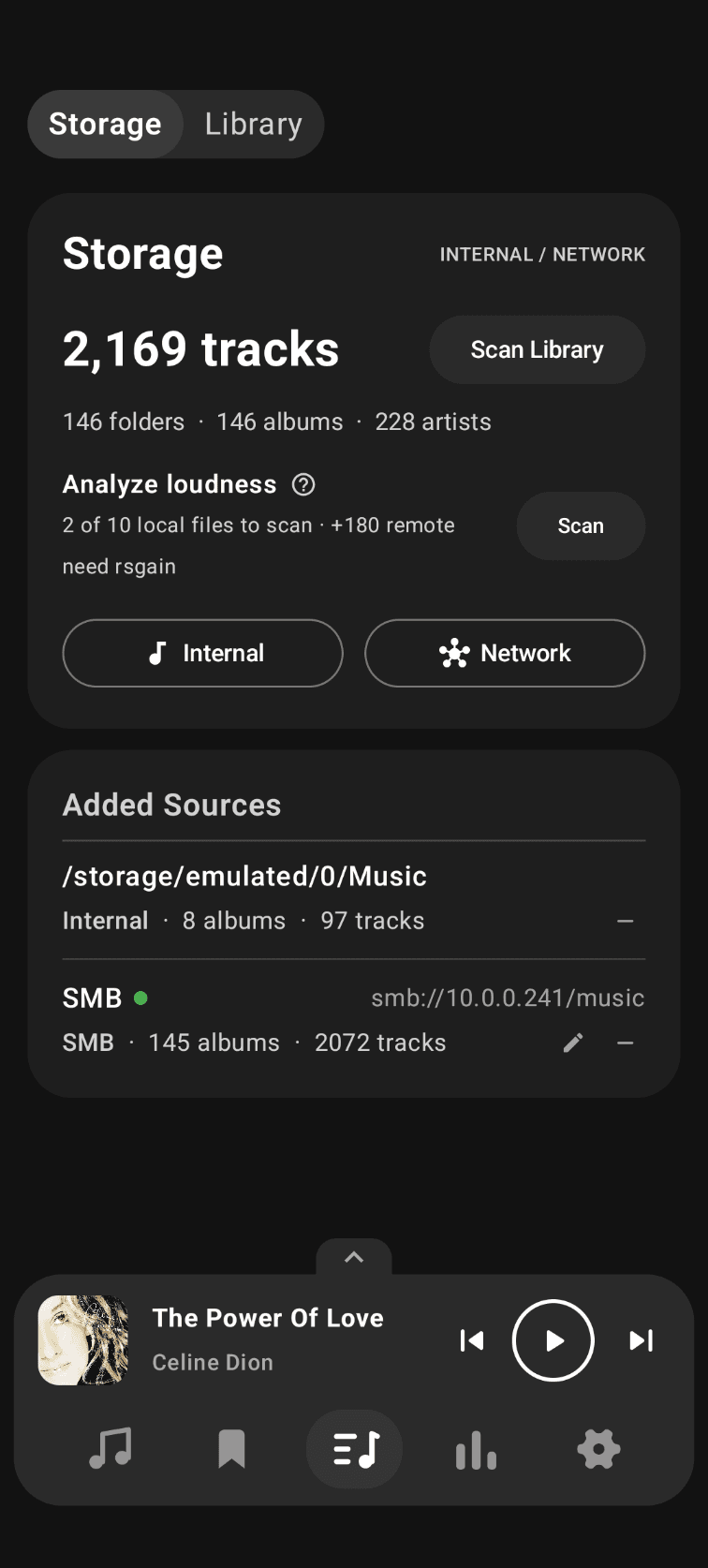
Album view with cover art, star rating, favourite toggle, track list and the mini player
Three output architectures
Lydex offers three heavily optimised output paths, one per kind of device and use case, striking a more precise balance between compatibility, sound quality and latency.
Exclusive USB DAC output
USB DAC / dongleA USB audio driver written from scratch drives the DAC over usbfs, bypassing the Android audio framework and its mixer for exclusive, stable bit-perfect output. Sample rate, bit depth and bit alignment are negotiated per device from the DAC descriptor, and the clock offset between the two is corrected continuously so playback stays exact.
Built-in DAC passthrough
The device's own DACOn Android devices with a high-quality DAC of their own, Lydex bypasses the system mixer and the processing stages in between, taking a shorter, cleaner path straight to the DAC so resampling and system interference are kept to a minimum.
Requires root. Supported on selected DAP models today, with more being added. See supported devices →
AAudio session-exclusive output
Bluetooth / system output / wiredUses Android's native AAudio low-latency exclusive path to bypass the system mixer, giving Bluetooth playback, system output and the wide range of Android devices an efficient, stable audio experience — lower playback latency and a cleaner signal, without giving up broad compatibility.
Whether you plug in a dedicated USB DAC, rely on capable built-in audio hardware, or simply play through the system output, Lydex picks the right path for you — stable, clean, and entirely under your control.
Formats and limits
Lossless first: FLAC, APE, WAV and DSD all play directly. Lossless decoding takes a path optimised for it specifically, so large files start instantly whether they sit on the phone or on a network share, and a single-file rip with a CUE sheet plays track by track.
- Sample rates
- 44.1 – 768 kHz
- Bit depths
- 16 / 24 / 32-bit
- Format
- FLAC · APE · DSD2 · WAV / PCM · AAC · MP3 · Vorbis
The rate you can actually reach depends on the device and on which output path is in use. Through the Android audio framework the ceiling is set by the system and the device audio HAL, and most handsets stop at 192 kHz. Exclusive USB DAC output and built-in DAC passthrough (root required) bypass the framework and address the hardware directly, supporting up to 768 kHz — not capped by Android, only by what the device descriptor declares, negotiated per device on connect.
- 2Three ways to send DSD: native DSD straight through, DoP v1.1 packed inside PCM frames, or decoded to PCM. Pick whichever your DAC supports — the player shows which one is in use.
Library and music management
More than a file list. Folder browsing and streaming-style browsing sit side by side, and favourites, ratings and smart playlists grow out of what you actually listen to.
Files and music, two ways to browse
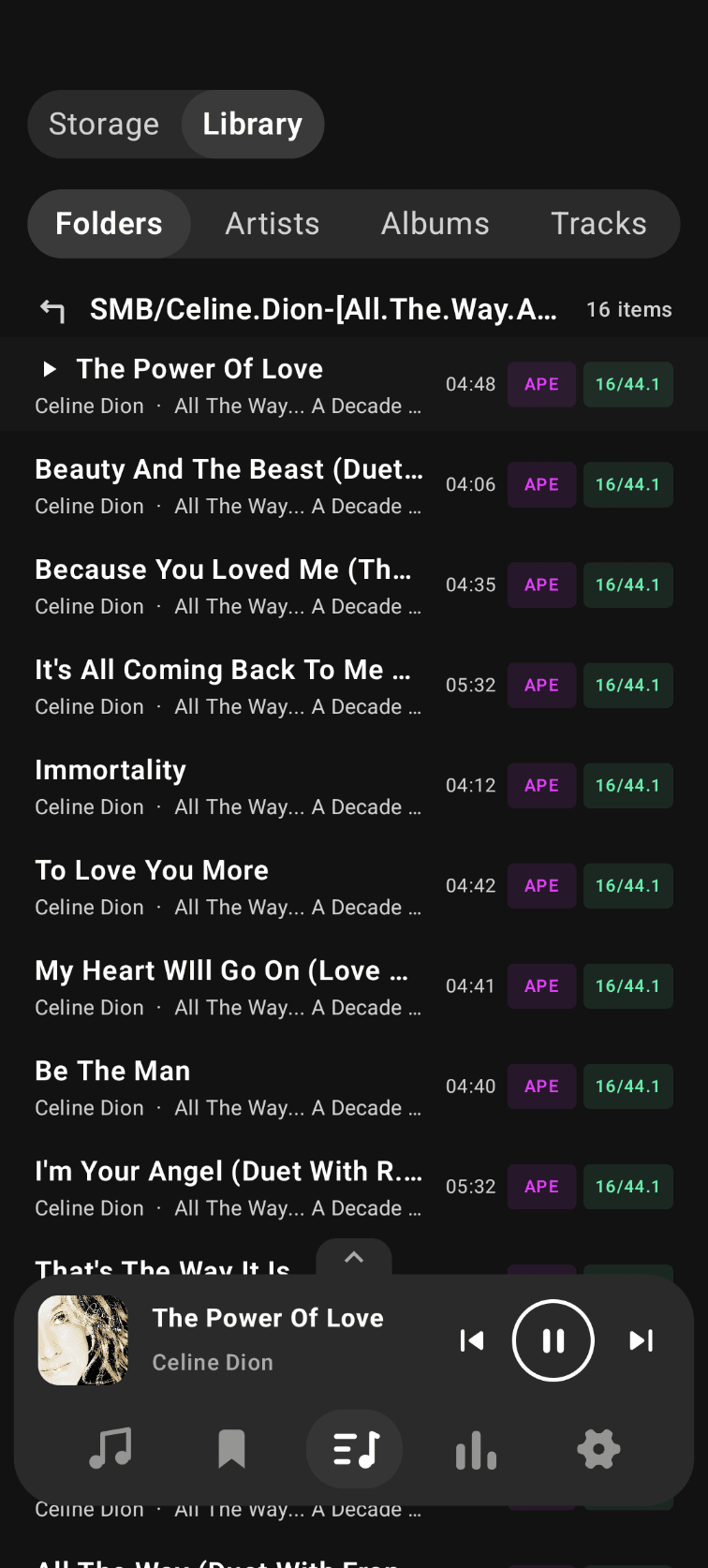
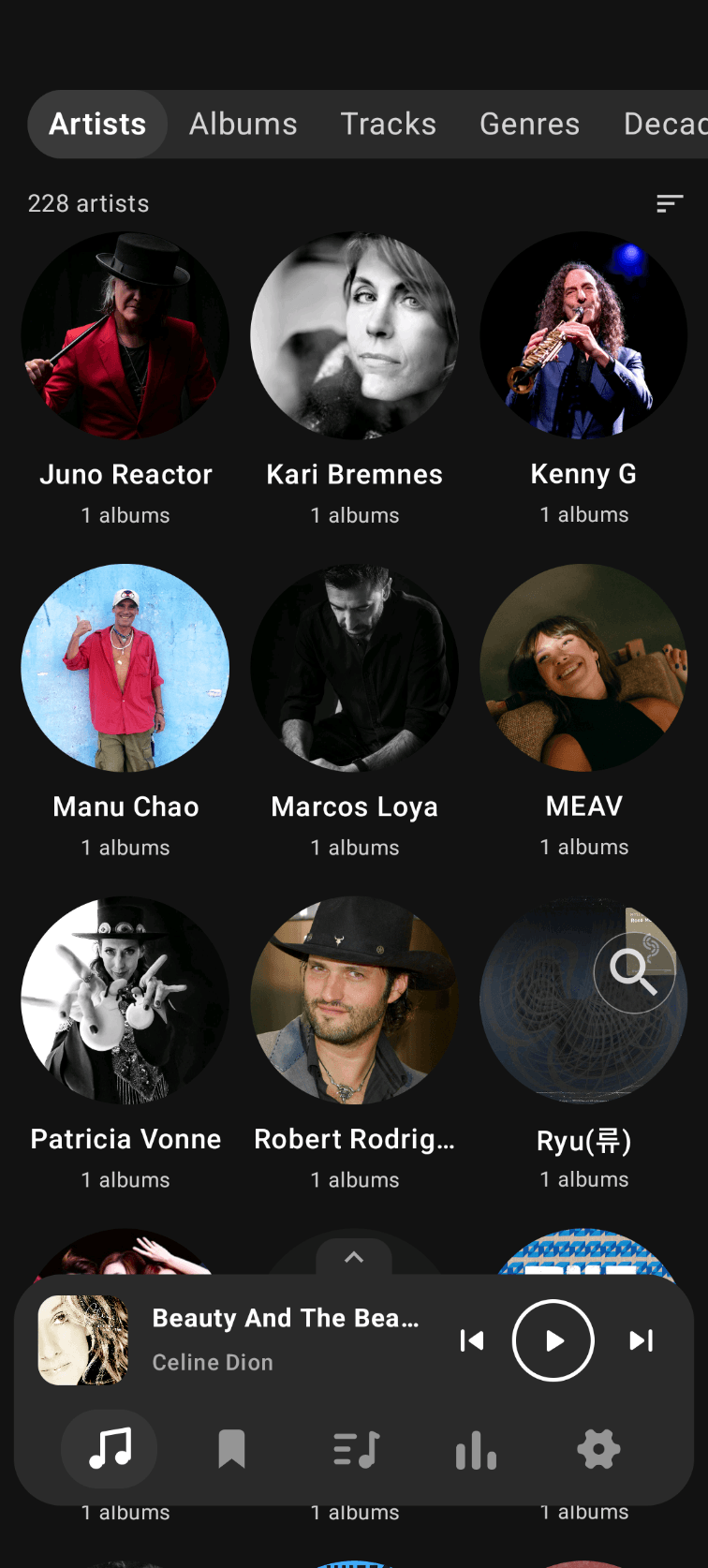
The library view opens as folders and keeps the directory structure you built yourself — play a collection you have already filed properly, without being forced into a tag-generated hierarchy. When you would rather browse than navigate, the music view lays the same files out by artist, album, track, genre and decade, the way a streaming app does. One set of files, two ways in.
Local and network in one library
Folders you grant access to and shares over SMB, FTP, WebDAV and UPnP all land in the same library, browsed, searched and played exactly the same way — no separate app just to reach the albums on your NAS.
Favourites, ratings and lists that fill themselves
Favourite tracks and albums separately. Top Rated ranks by the stars you gave it, Top 100 by play count, and a recent-plays list sits alongside them — none of the three needs maintaining; they fill in as you listen. Ratings live in a side table keyed by a content fingerprint, so rebuilding the library or moving the music to different storage never loses them.
Playlists that assemble themselves
Rules can match on rating, year, codec or sample rate, combined with ALL or ANY. Codec and sample rate being usable as conditions is the part other players do not offer: "FLAC at 24-bit/96 kHz or better, rated four stars up" is a valid list. And it recomputes against the live library — change a rating or add a favourite and the playlist follows.
The built-in DSP chain
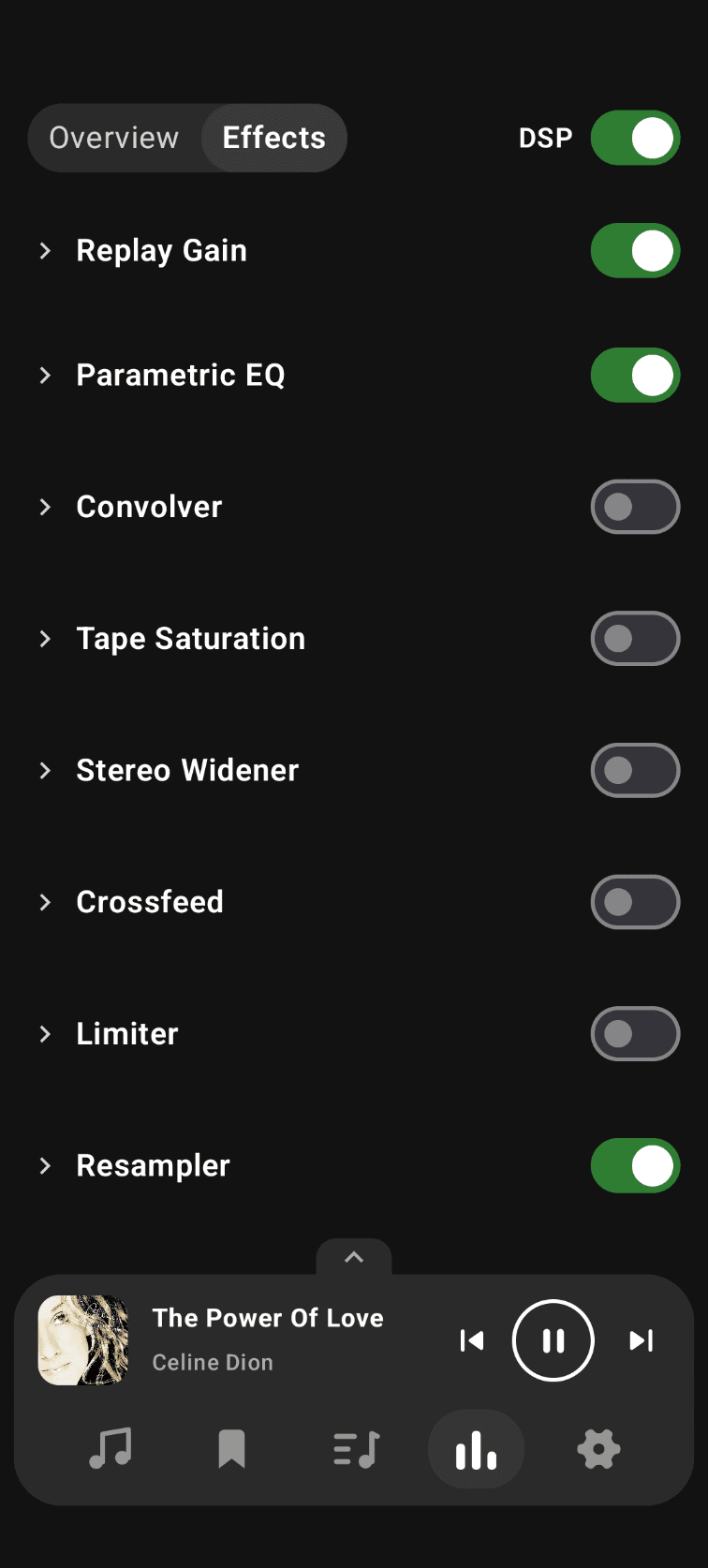
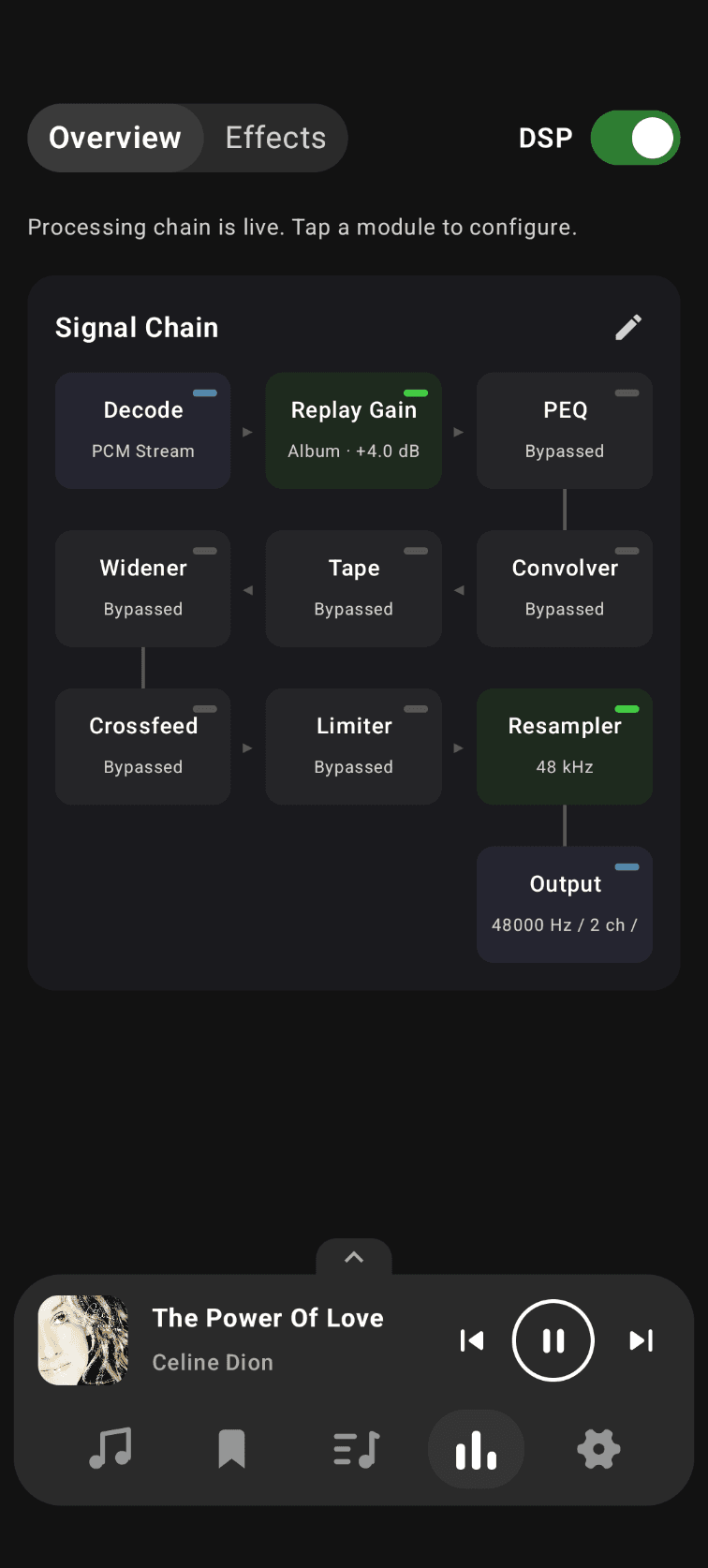
Eight modules in series, each switched or bypassed on its own. The middle six can be dragged into whatever order you want; ReplayGain is pinned to the head of the chain and the resampler to the end, with decode and output equally immovable. The chain is drawn out inside the app, so you can see at a glance which stages are live, and all of it is processed at 64-bit precision.
| Module | What it does |
|---|---|
| ReplayGain | Reads the track or album gain tag and levels the volume differences between albums — loudness only, nothing tonal. Pinned to the head of the chain, so EQ, saturation and limiting all work from an already-normalised level. |
| Parametric EQ | Correction band by band: add or remove bands, each with its own frequency, Q and gain. |
| Convolver | Load an impulse response for room or headphone correction; swapping one cross-fades instead of popping. |
| Tape Saturation | A touch of even-order warmth, with the low end routed around the nonlinearity so the lower mids stay clean. |
| Stereo Widener | Widens the stereo image while folding everything below a chosen frequency back to mono — wider, without losing the bass. |
| Crossfeed | Feeds each ear a little of the opposite channel, the way speakers do, so the image stops sitting inside your head. |
| Limiter | Catches peaks so an EQ boost or a hot saturator cannot clip the output. |
| Resampler | Matches the output sample rate. Pinned to the end of the chain and engaged only when you turn it on — on a bit-perfect path it stays bypassed. |
The DSP chain was designed to be extended at runtime, and more DSP plugins are on the way.
And the rest
The sections above cover the skeleton. These are not afterthoughts — they just do not need a long explanation.
Artwork fetched automatically
Missing album covers are fetched online along with artist portraits and cached locally. When several candidates exist you pick one, with each resolution shown.
Lyrics
Tap the cover to flip to the lyrics, with line-by-line LRC sync. If they drift, nudge the offset and it is remembered — no need to edit the file.
A spectrum worth looking at
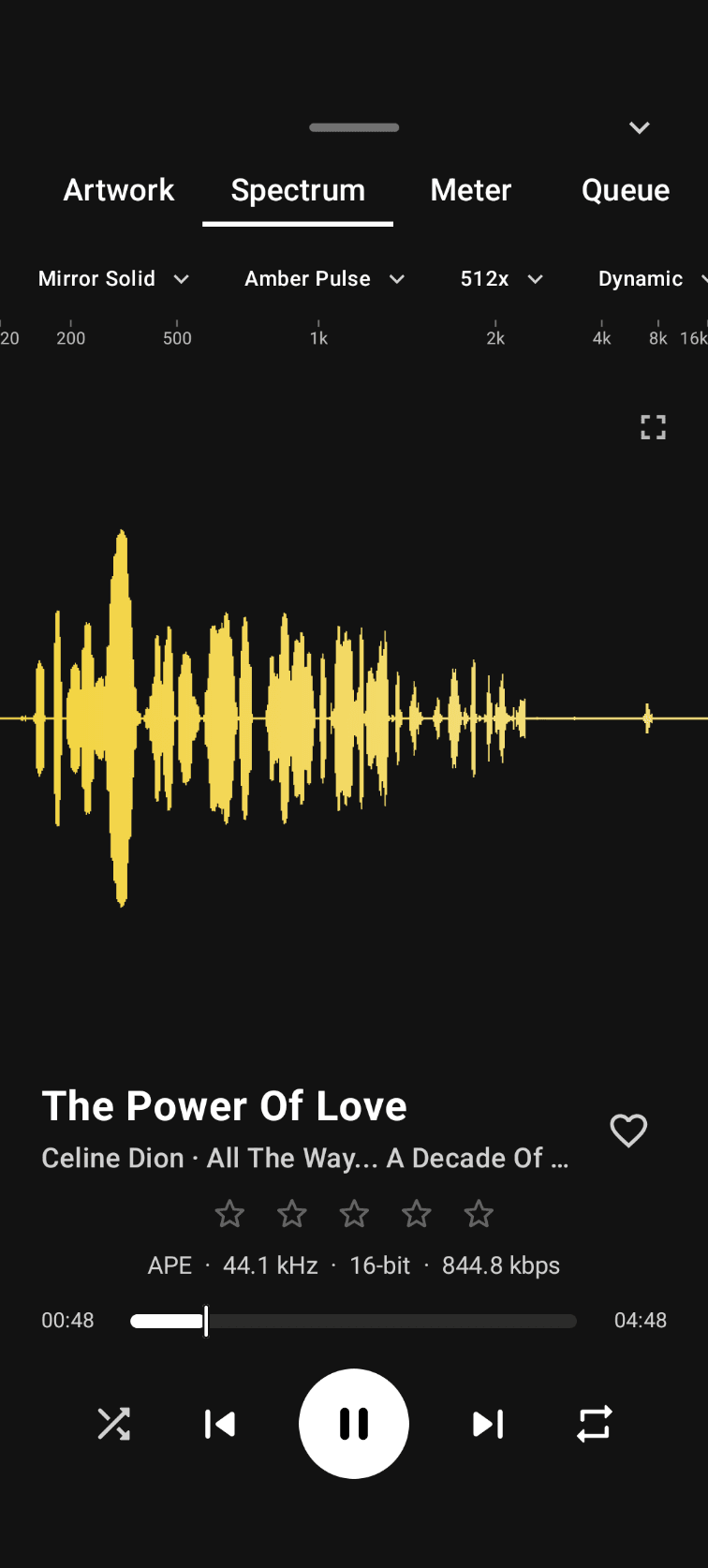
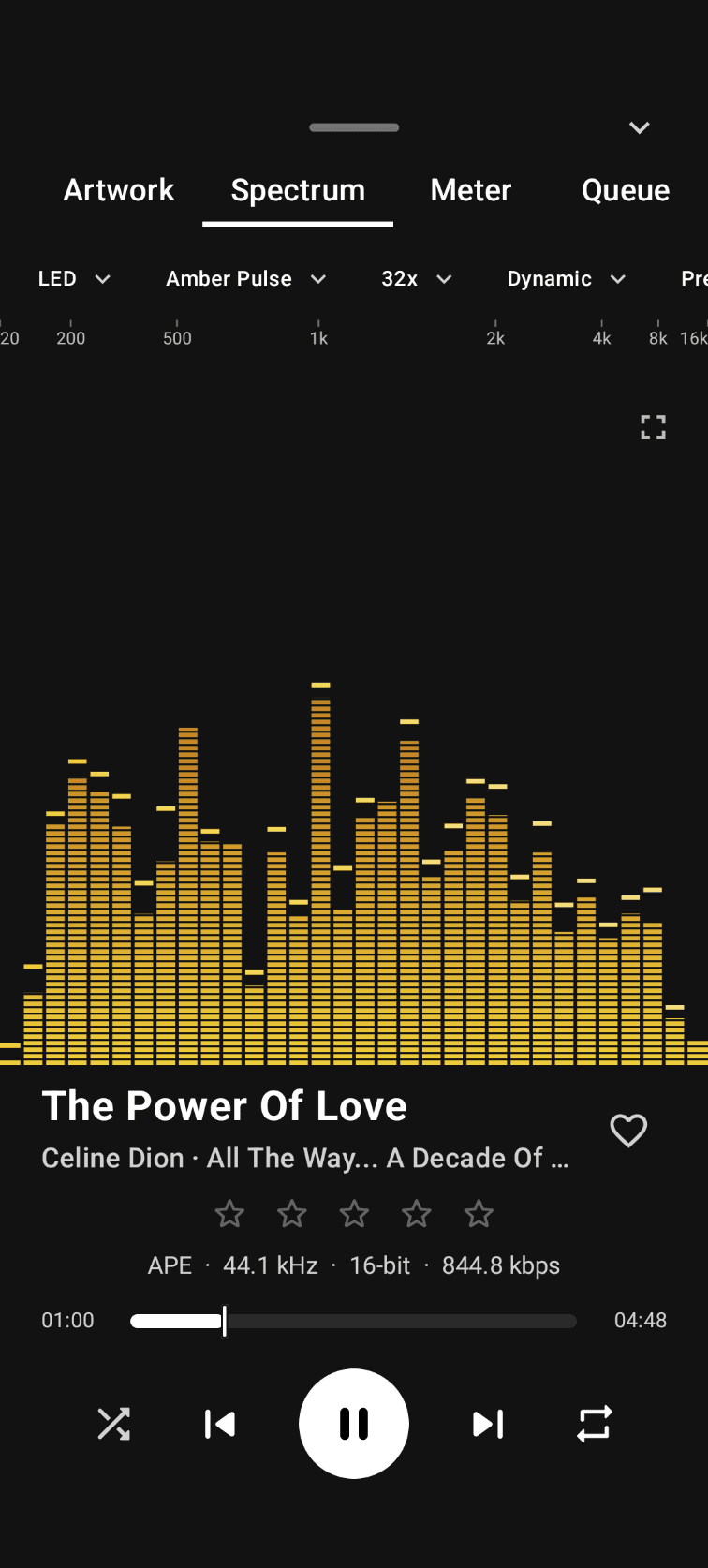
28 render styles — bars, mirrored, waterfall, terrain, particles, aurora, radial, tunnel, phosphor, right through to a stereo vectorscope — plus 17 palettes, five response curves and 4 to 512 bands, all switchable mid-playback.
An EBU R128 meter
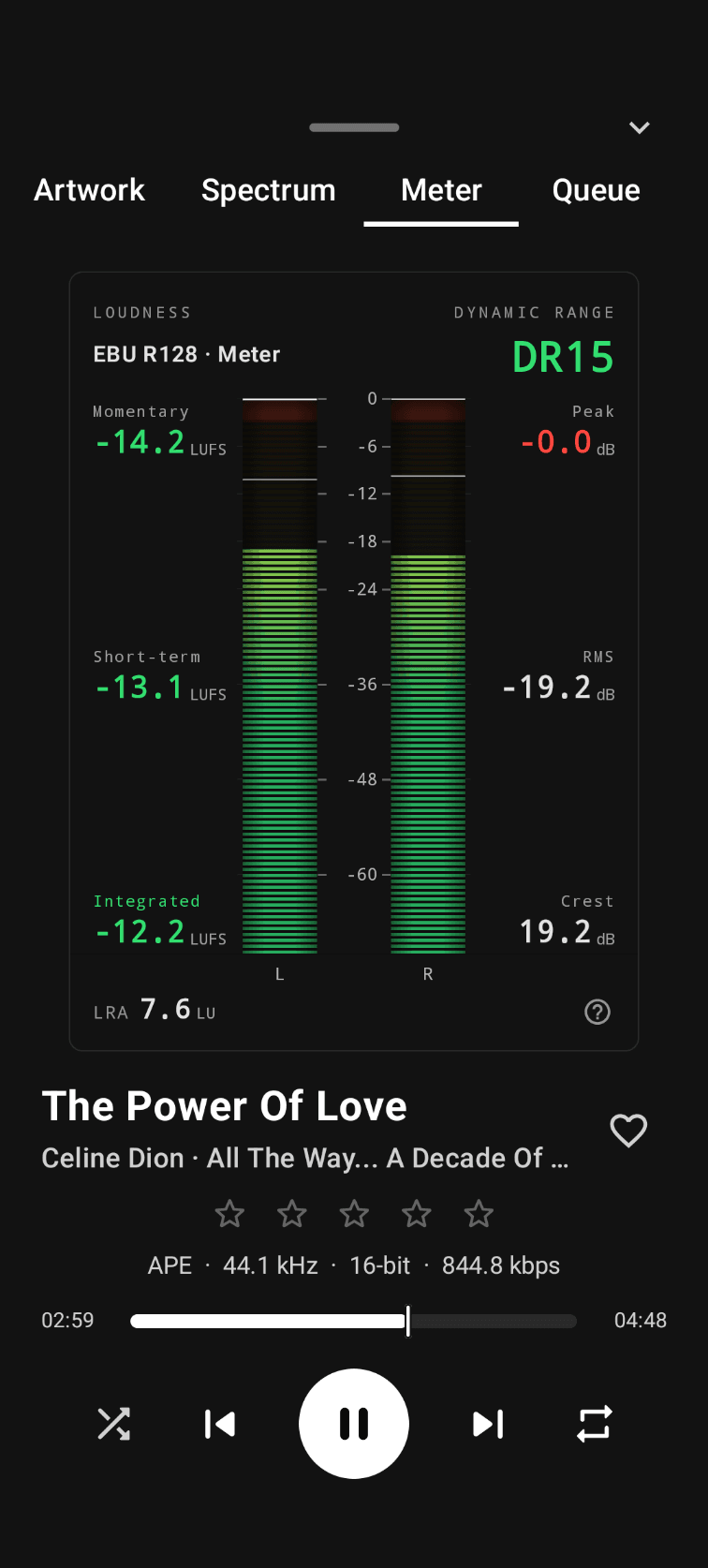
Momentary, short-term and integrated loudness plus peak, RMS, crest factor and LRA on one screen, with the DR figure called out.
Gapless playback
One track runs straight into the next, with none of that half-second of silence in between. On a live album, a symphony, or any record meant to be heard whole, that half second is exactly what breaks the spell.
Last.fm scrobbling
Link an account and plays are scrobbled automatically; disconnect whenever you like. Leave it unlinked and nothing is sent.
Home-screen widgets
Two of them: a compact now-playing card with transport controls, and a fuller one that shows the queue.